

Elementor SEO is more competitive than ever: as of July 2026, Elementor powers roughly 13% of all websites worldwide — about 18.6% of every site built on a known CMS (W3Techs). The takeaway: millions of businesses compete for the same rankings, and the edge goes to whoever does Elementor SEO right.
Elementor is, without a doubt, one of the most popular and convenient tools for building WordPress sites. But when it comes to Elementor SEO in the new era of 2026, business owners and marketers keep asking the same question: can you really reach the top of Google — and get surfaced by AI engines — with a site built on a page builder?
The short answer: absolutely yes. But to get there, you have to compensate for the platform’s core weakness with a smart, modern promotion strategy built for AI-powered search.
This guide shows exactly how, diving into three key concepts every site owner and marketer must know:
- Entities,
- the Core 30 strategy,
- and Markdown/JSON pages for AI agents.

Elementor SEO: The Technical Challenge of Page Weight
Elementor’s main drawback is what’s known as “code bloat.” Sites built in clean, custom code load fast, which gives them a ranking edge. An average Elementor site, by contrast, loads dozens of unnecessary script files. Load speed suffers — and that’s a critical factor in Elementor SEO.
And this isn’t just technical — it’s money: according to Google research (Think with Google), 53% of mobile visitors abandon a site that takes more than 3 seconds to load, and as load time grows from one second to three, the probability of a bounce jumps by 32%. Elementor sites tend to be heavy, so Core Web Vitals optimization is a prerequisite, not a luxury.
How Elementor SEO Solves the Speed Problem
First, Elementor sits on WordPress. That gives you a huge advantage over closed systems like Wix or Shopify, because you get full control over your URLs and site structure. Second, to offset the slowness, advanced caching plugins are a must. On top of that, choose a very fast host and strip unnecessary design elements from your pages.
Once you’ve squared away the technical side, the real game begins. Here’s how you beat the competition on content and relevance.
The Age of Entities: Keywords Step Aside
For years, SEO was built on “keywords.” We’d check search volumes, see how often people searched “criminal lawyer in Tel Aviv” each month, and stuff that phrase into our text.
To rank an Elementor site, you have to stop writing generic blog posts chasing long-tail keywords and start building your site around clear entities. If you’re a pest-control company, you need to establish yourself as a local entity that’s an expert in “bed bug treatment,” “cockroach spraying,” and so on. The AI engine will recommend you not because you have the keyword in your text, but because its system has confidently identified that your business actually provides that specific service in the specific location the user asked about.
The Core 30 Strategy: Mirroring Your Business Power
The Core 30 method is a framework we developed in-house (it is not an established industry term). Its purpose is to establish your entities in Google’s eyes.
What Does It Mean?
This strategy requires perfect synchronization between your Google Business Profile (GBP) and your website. The aim is to create dedicated, separate, in-depth service or product pages on your Elementor site for each and every category and service listed in your Google profile.
A serious local business typically offers around 30 different services (a plumber, for example, doesn’t just offer “plumbing,” but “root blockage clearing,” “full pipe replacement,” “concealed cistern repair,” and so on).
You need to create (using Elementor) about 30 distinct pages. The single most important rule: the page Title and the URL must be identical to the service name exactly as it appears in your Google Business Profile. This precise mirroring signals to Google’s algorithm that you are the most authoritative and relevant address for that specific service — which lifts you significantly in local results (Google Maps).
The Secret Page: Markdown / JSON and AI-Readiness
The most advanced stage of SEO today is called GEO (Generative Engine Optimization). The goal is to get AI bots — like those powering ChatGPT or Google Gemini — to understand your business and “recommend” it to users asking questions.
And this is no longer futuristic: Google’s AI results (AI Overviews) already appear on roughly 48% of tracked searches — up from 31% a year earlier (BrightEdge, 2026). In nearly half of all searches, Google answers the user before they ever reach your site — and if your content isn’t built so AI can cite it, you’ve missed out.
AI bots don’t much like reading pages full of noisy design, animations, and heavy code (exactly what Elementor produces). They like clean, dry, orderly text.
This Is Where the Markdown / JSON Solution Comes In:
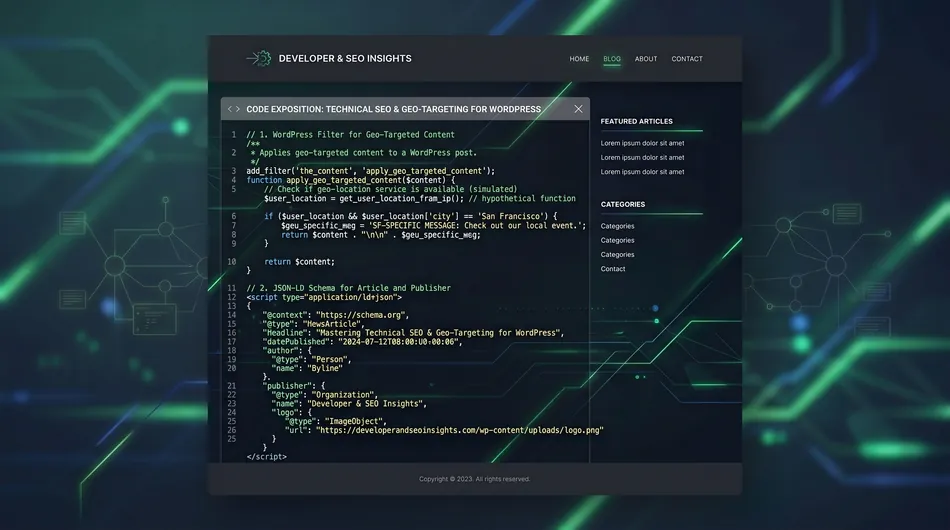
The most cutting-edge SEO tactic today is to create a dedicated page on your site (often hidden from the main navigation but visible to search engines), usually called “Data for AI Agents.”
This page is built in very simple text format (like Markdown) or as a structured data object (JSON-LD). It contains all the “dry facts” about your business:
- Business name and history.
- Address, hours, and service area.
- The exact list of services with prices.
- Your team’s expertise credentials (to strengthen authority — E-E-A-T).
When a Perplexity or ChatGPT bot crawls your site, instead of getting lost in dozens of Elementor scripts trying to figure out what you sell, it finds the Markdown/JSON page and “pulls” the facts instantly. This makes your site AI-Ready and gives you an enormous competitive edge.
Elementor SEO in 2026: The Bottom Line
An Elementor site may be heavy on code, but in 2026 that’s no excuse for not being #1. If you invest in fast hosting to offset the technical weight, build a smart hierarchy based on entities (not keywords), apply the Core 30 strategy to connect perfectly with Google Maps, and add a Markdown/JSON page built specifically for AI bots to read — you won’t just rank your site, you’ll leave every competitor in the dust.
Frequently Asked Questions (FAQ): Elementor SEO and AI
Can you really reach #1 on Google with a site built in Elementor?
Absolutely. Although Elementor produces “code bloat” that can slow a site down, you can compensate with a strong host and advanced caching plugins. And because Elementor is built on WordPress, you have full control over your URLs, site structure, and schema implementation — a huge advantage over closed platforms like Wix or Shopify.
Why do AI bots need a special Markdown / JSON page?
AI bots (like those of ChatGPT, Perplexity, or Google Gemini) want information fast and cleanly. Elementor sites contain a lot of scripts, design code, and animations that make it hard for bots to extract the important information. Creating a Markdown or JSON page that holds only the “dry facts” about the business (services, service areas, prices) lets AI crawl you in a second, understand exactly what you do, and recommend you to users.
What's the difference between keyword-based and "entity"-based SEO?
In the past, SEOs checked which words people searched and simply stuffed them into the text (for example, “lawyer in Tel Aviv”). In 2026, that approach is no longer relevant. Search engines are now built on a “knowledge graph” made of entities. The goal isn’t to insert a specific word, but to prove to the search engine that your business is the real, best authority in that field and geographic location.
How does the Core 30 strategy help with Google Maps (Local SEO)?
The Core 30 strategy is based on creating a perfect match (mirroring) between your Google Business Profile and your website. The idea is to set up about 30 separate service pages on the site, each dedicated to a specific service listed in your Google profile. Once Google sees that a page on the site matches one-to-one (in title and URL) with a service defined in the business profile, it signals to the algorithm that you’re especially relevant to that service — which boosts your ranking in Maps.