

Most new websites wait three to six months before Google shows them on the first page, and most never get there. Ahrefs found that only 1.74% of newly published pages reach Google’s top 10 within a year (Ahrefs, 2025).
The site we rebuilt for Flash Parking Systems took 16 days. It went live on 9 October 2026. On day 16 it was third on Google’s first page for its main search term. On day 23 it was still third, and Google’s AI Overview for the same search listed it as a source.
This was not luck and not a trick. The old site was invisible to Google for a technical reason, the new one was planned from research before any design, and every page was built to answer one search. Below is each step with the real numbers, including the parts that made this result easier than it looks.
| Before | After | |
|---|---|---|
| Pages Google could read | none | every page |
| Position for the main search term | not in the top 10 | 3rd on day 16, 3rd on day 23 |
| Google AI Overview | not cited in any of 24 searches checked | listed as a source |
| Lighthouse performance, mobile | 55 | 96 |
| Largest Contentful Paint, mobile | 15.3 s | 2.4 s |
Where the site started
Flash Parking Systems builds and runs paid parking lots, with plate recognition cameras, barriers, payment terminals and its own management software. The company is young, and its domain was registered in January 2026.
The old site was a single static HTML page of 3.26 MB. Twenty-one images were embedded in the code as base64 text, and they came before the content. The <body> tag started at byte 3,153,650.
Google’s documentation says Googlebot crawls the first 2 MB of a supported file type (Google Search Central). Everything after that is ignored. So Google downloaded the page and read none of its words. Many AI crawlers cut responses even earlier.
The rest of the setup made it worse. Every address on the domain returned the home page with a 200 status, so there was no real 404, no sitemap, no robots.txt, no canonical tags and no structured data. On mobile, Lighthouse scored the page 55, and the main content took 15.3 seconds to appear.
There was one more problem that had nothing to do with code. A much larger US company called FlashParking shares almost the same name. When people or AI systems looked for “Flash parking”, they found the other company.
When we checked 24 commercial searches in October, Flash appeared in none of the results and in none of Google’s AI answers.
Research came before design
Before anyone opened a design tool, we spent the first days on research. It produced three documents, and every later decision came from them.
A company dossier. Who the company is, what it sells, where it has installed systems, what customers say, and how it appears online. Every fact is marked confirmed, estimated or not found. This matters more than it sounds. AI systems repeat facts about a business, so the facts on the site have to be right and identical everywhere.
A competitor list filtered by evidence. Plenty of companies rank for parking terms. Far fewer actually sell paid-parking systems in this segment. We kept only competitors with visible proof of real installations and sales, and studied how those few present themselves.
A demand map. We measured monthly search volume for 138 search terms, reviewed 339 more term ideas, read 24 Google result pages one by one, and pulled the rankings of six competitors.
What the research measured
What the numbers showed
Three findings shaped the whole site.
First, demand is small. The whole business-to-business category gets fewer than 300 searches a month, and the best term a parking-lot owner types gets about 40. So search traffic alone was never going to fill a sales pipeline. Search had a different job. A buyer who hears about Flash from a salesperson or a payment partner needs to find a real company with real projects when they look it up.
Second, Google showed an AI Overview on 23 of the 24 commercial searches we checked, and none of them carried ads. Buyers often read that summary instead of clicking a site. So the goal became being a source of that answer, in addition to ranking as a normal result.
Third, some useful searches had no good answer at all. For “how to build a paid parking lot”, the top 10 held only general information pages and not a single contractor. Small volume, but the first detailed page from a company that actually does it has a real chance of becoming the source.
Search terms that look good and are not
Several terms had healthy volume and would have been easy to target. Reading the actual result pages showed that the people searching them wanted something else.
| Search term (translated) | Searches a month | What Google actually shows |
|---|---|---|
| parking barrier | 2,400 | locks for a single private parking space |
| electric gate | 1,000 | gate manufacturers |
| LPR camera | 590 | news about city cameras and traffic-fine lawyers |
| paid parking | 590 | drivers looking for somewhere to park |
| licence plate recognition | 390 | used-car checks by plate number |
Building pages around any of these would have brought visitors who were never going to buy a parking system. We mention some of them in the text where they are true, but none of them leads a page.
One page answers one search
Each page got one main search to answer, and no two pages share a main search. That way pages never compete with each other, and Google always knows which page to show.
| Page | Main search it answers |
|---|---|
| Home | parking control |
| Parking system | parking management system |
| Gate opening by phone | open a gate from your phone |
| Parking construction | building a paid parking lot |
| Guides | how to build a paid parking lot, and other owner questions |
| Each project | the project name and city |
The main term goes into the title, the meta description, the first paragraph and one subheading. Secondary terms go into other subheadings and the body, only where they are true. Project pages carry the name and city of each real installation, because that is how competitors in this market get most of their traffic.
Built in code, not in a page builder
The new site is custom WordPress with a theme written for this project. Content lives in structured fields, so the client edits text and images without touching the layout. Yoast handles titles and sitemaps, and a small extension adds the company’s own structured data.
What made it fast is mostly what we left out.
- Images are separate WebP files with fixed width and height, and everything below the first screen loads lazily.
- Fonts are served from the same server, three files of about 96 KB in total.
- JavaScript covers only what the pages use, such as the mobile menu and the project gallery.
- Nothing is embedded in the HTML as base64, so the text starts in the first kilobytes.
| Mobile, Lighthouse | Old site, 8 Oct 2026 | New site, 1 Nov 2026 |
|---|---|---|
| Performance | 55 | 96 |
| Largest Contentful Paint | 15.3 s | 2.4 s |
| Data transferred | 2.5 MB | 666 KB |
| Where the text starts | after 3.15 MB | in the first kilobytes |
| SEO | 92 | 100 |
The new-site figures are the median of three runs on 1 November. Lighthouse varies between runs, and one of the three scored 86.
If your site is slow for similar reasons, our WordPress speed optimization page explains how we approach it. The project card is in our works.
Four layers for AI answers
AI answer engines can only cite what they can reach, locate, understand and quote. We worked through these four layers in order, because each one depends on the layer before it. Our guide to generative engine optimization covers the idea in more depth.
- Access. Crawlers from Google, ChatGPT, Perplexity and Claude get the same page a browser gets. We tested seven bots through the CDN, because a firewall can block a bot that robots.txt allows.
- Address. Every URL returns its own page, unknown URLs return a real 404, robots.txt points to a sitemap of indexable pages only, and an llms.txt file lists only live pages.
- Understanding. Organization structured data carries the legal name, company number and phone, exactly as they appear everywhere else. The About page states plainly that the company is not related to the US company with a similar name.
- Citability. Each main page opens with a short paragraph that answers its search directly and ends with an FAQ marked up as FAQPage. Pages use real numbers and real project names, which AI systems prefer to quote.
The result, with dates
| Date | Day | What we saw |
|---|---|---|
| 9 Oct 2026 | 0 | new site live |
| 25 Oct 2026 | 16 | 3rd on Google’s first page for the main search term |
| 1 Nov 2026 | 23 | still 3rd, and listed as a source in Google’s AI Overview |
We checked with non-personalised Google searches.
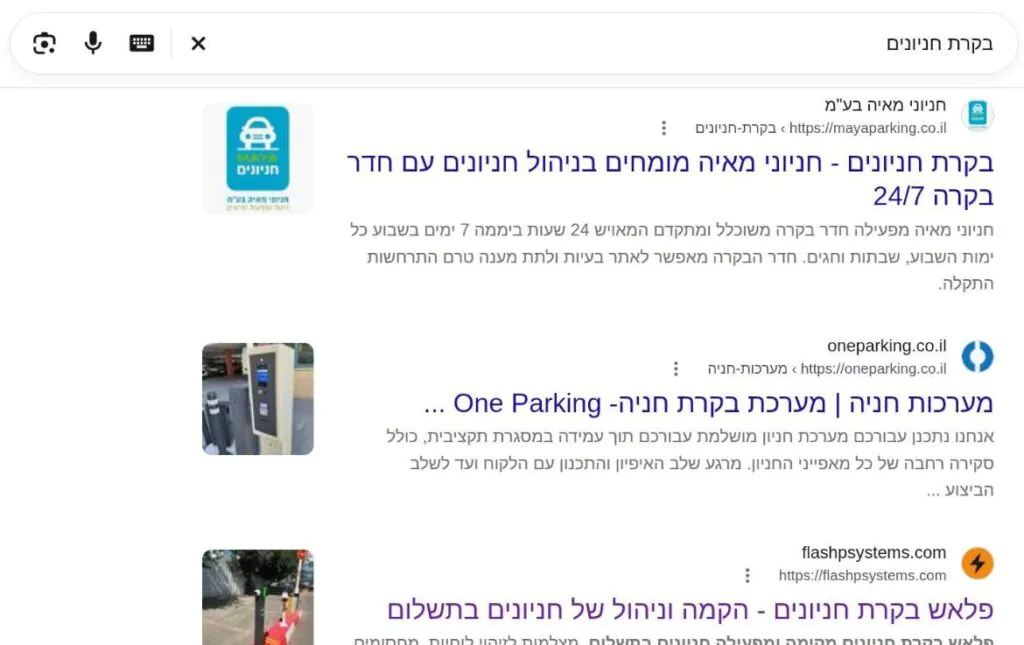
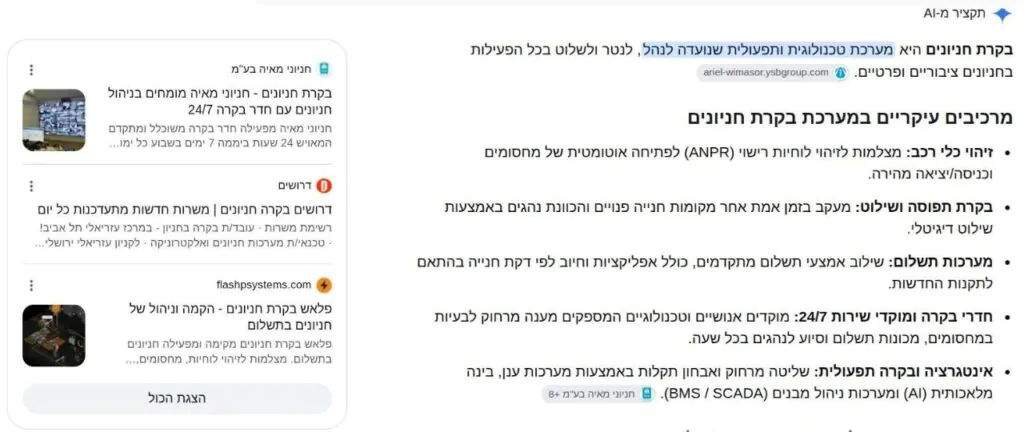
There are two things we do not know yet. We did not check rankings every day, so the site may have reached the first page before day 16. And AI Overviews change between page loads. On one load the site appeared as a source card, on another the summary cited different sites.
What this case does not prove
This result is real, and it is also easier than it looks. Anyone judging it should know four things.
- The niche is small. The whole category gets fewer than 300 searches a month, and competition is lower than in most markets.
- The term helps itself. The main search term is part of the company’s legal name, which makes the page an obvious match, and it gets about 10 searches a month.
- It is one term and one AI answer. This is a visibility result, not a traffic or sales report.
- Crowded markets take longer. In fields like law, real estate or general marketing, the same method works, but it needs months and outside links, not days.
What you can copy for your own site
- Check where your text starts in the page source. If inline images or scripts push it past 2 MB, Google may not see it at all.
- Make every URL return its own page, and return a real 404 for addresses that do not exist.
- Measure demand before you decide which pages to build, and read the actual result page for each term.
- Give each page one main search and never let two pages chase the same one.
- Keep the facts about your company identical everywhere, including in structured data.
- Open each page with a direct answer and close it with an FAQ.
- Write down dates when you check rankings, and check again.
Frequently asked questions
How long does it usually take a new website to rank on Google?
Usually three to six months, and many pages never reach the top 10. Ahrefs found that only 1.74% of newly published pages get there within a year. Small niches and technically clean sites can move faster, as this case shows.
Can a site built with a page builder rank this fast?
It can, if the builder’s output is light and the text is readable early in the page. Heavy builder markup and scripts make it harder. We measured this on a clean install in our Elementor SEO test.
What is a Google AI Overview, and how does a site get cited in it?
It is the AI-written summary Google shows above the normal results for many searches. Google cites pages it can crawl, understand and trust. In practice that means fast pages, consistent company facts in structured data, and short passages that answer the question directly.
Why start with research instead of design?
Because the research decides which pages exist. Without it, this site might have been built around “parking barrier”, a term with 2,400 searches a month that brings people looking for a lock for their own parking space.